Pray
for Me

Patron Saint of Difficult, Impossible, & Hopeless Cases
Pray
for Us

|
|
Pray for Me |
|
Patron Saint of Difficult, Impossible, & Hopeless Cases |
|
Pray for Us |
|
|
|
|
|

 |
“If thou wilt receive profit, read with Humility, simplicity and Faith; and seek not at any time the fame of being learned.”
(Thomas a'Kempis, Imitation of Christ, Book I, Chapter 5:2;4.) |
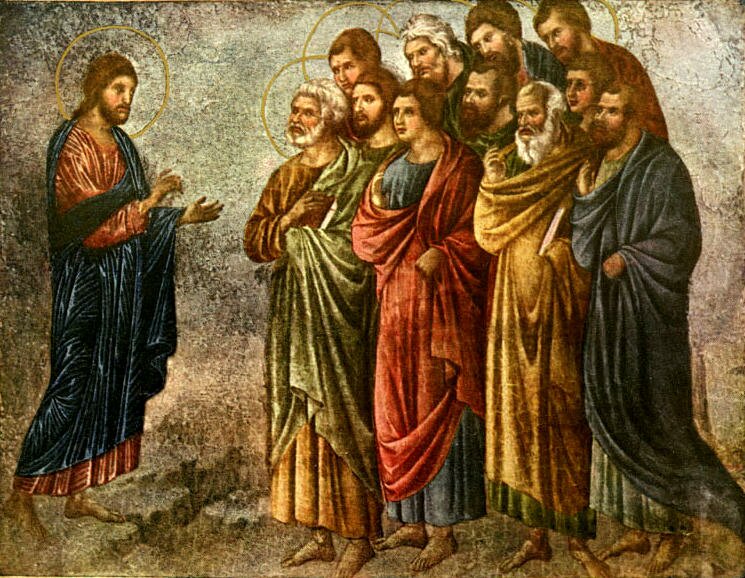
“And He [Christ] called the Twelve; and began to send them two and two, and gave them power [i.e. Ordained them Exorcists] over unclean spirits [Devils]” (Mark 6:7).
“The Apostles and their successors are God’s Vicars in governing the Church which is built on Faith and the Sacraments of Faith. Wherefore, just as they may not institute another Church, so neither may they deliver another Faith, nor institute other Sacraments...” (Saint Thomas Aquinas, O.P., [b. 1225 A.D. in Rocca Secca, Naples, Italy - d. Wednesday, March 7, 1274 A.D., in Fossa Nuova, Italy], Doctor of the Church, Summa Theologica, Part III, Question 64, Article 2, Reply to Objection 3; emphasis added).

A Roman Catholic Priest Offering the
Catholic Traditional Rite of Mass
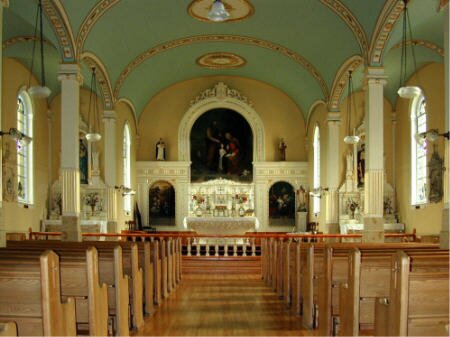
Full View of the Sanctuary
Please Notice the two Side Altars which are partially hidden by pillars. Also note all of the beautiful paintings, the beautifully painted statues, and the art work on the ceiling and the tops of the arches
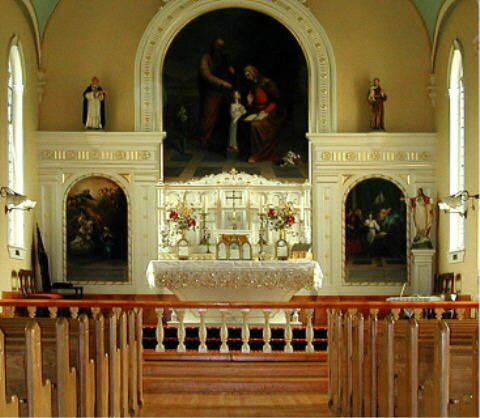
Closer View of the Sanctuary

Sanctuary During a Sunday Mass at a very Ornate Altar
Note all of the Statues, candles, and the steps going up to the Altar
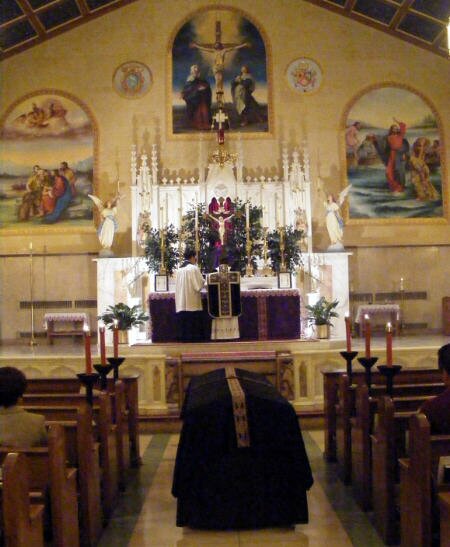
Sanctuary During a Requiem Funeral Mass
Notice the Black Vestments and the 6 Black Candlesticks and Unbleached Wax Candles
on either side of the Casket Which is Covered with a Black Funeral Pall.
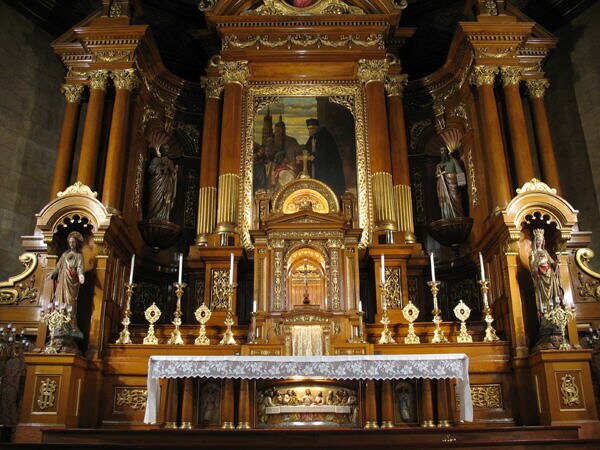
Very Ornate Wooden Altar and Sanctuary
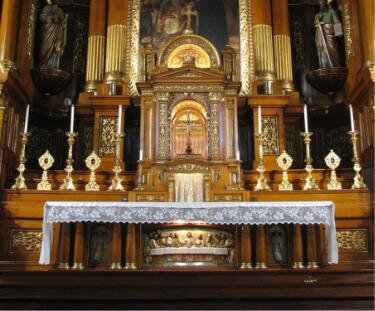
The Altar Itself including a few of its Steps
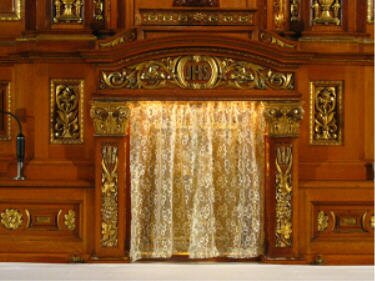
The Tabernacle with a Tabernacle Veil
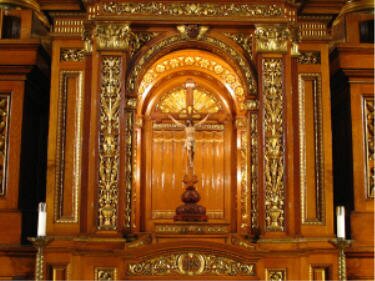
Traditional Altar Crucifix
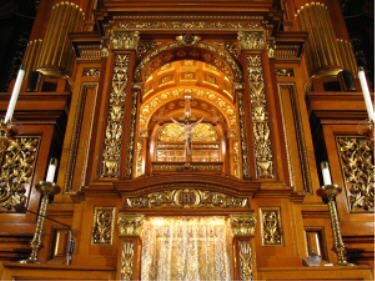
Canopy or Throne of Altar
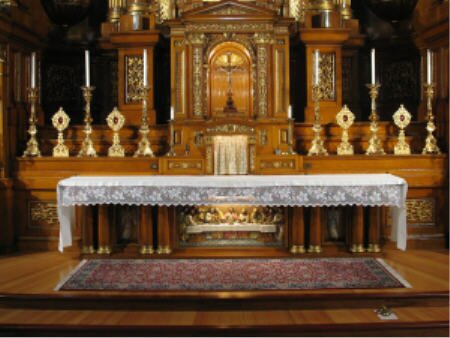
The Three Altar Cloths on the Mensa or top of Altar
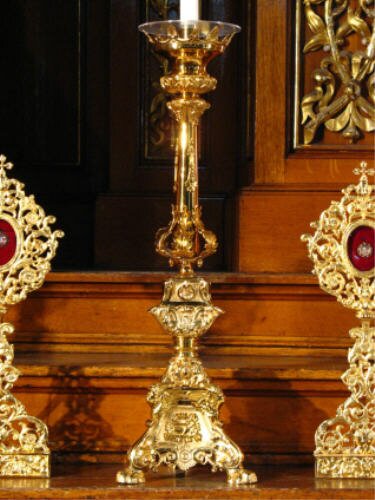
Ornate Candlestick

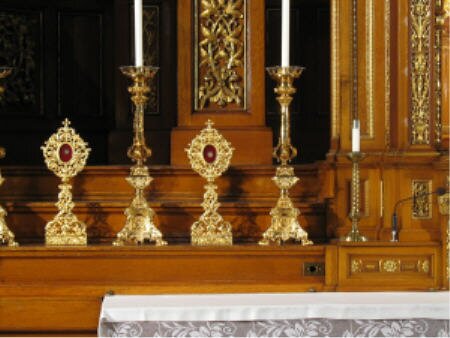
Ornate Reliquaries
Contain Holy Relics of the Saints
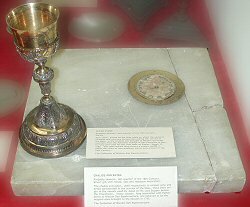
Sepulchrum or Altar Stone of solid Marble
Except for a small hole cut into it for Relics
A Chalice and Chalice Paten are sitting on it. It contains the Relic(s) of Holy Catholic Martyrs. The Altar Stone is permanently set into the top of the Altar so that the top of the Altar Stone is flush or even with the top of the Altar.
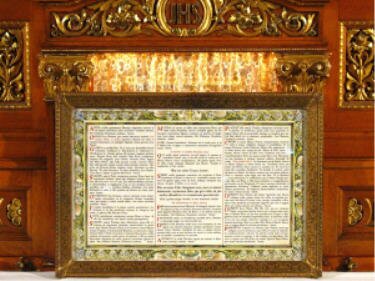
Center Altar Card
Placed in Front of Tabernacle During the Mass
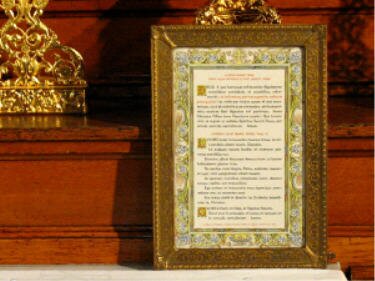
Deus, Qui humanae, Lavabo, and Corpus Tuum, Domine
Altar Card on Epistle (right) Side of Altar
The Deus, Qui humanae prayer is said when a few drops of water are added to the wine at the Offertory. The Lavabo prayer is said at the washing of the hands. The Corpus Tuum, Domine prayer is said when plain wine and water are used to purify both the chalice and both thumbs and forefingers of the Priest after Holy Communion.
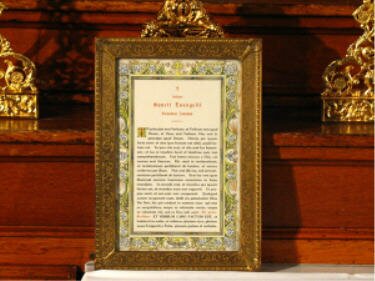
Last Gospel Altar Card on Gospel (left) Side of Altar
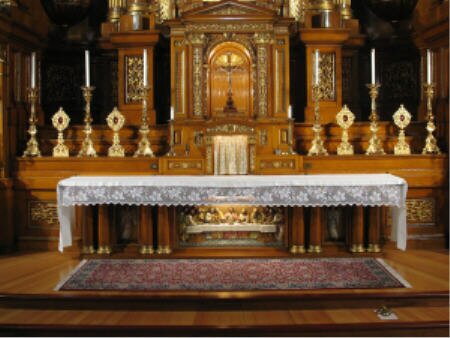
Altar Carpet on the Predella or top of the platform on which the Altar sits
Wine and Water Cruets are sitting in a Lavabo Basin. A Lavabo Finger Towel on another Lavabo Basin. A Round, Gold-Plated Paten with a handle for an Altar Boy is used to put under the chin of each Person Receiving Holy Communion in case a Consecrated Host falls, it will fall on the Paten and neither on the fingers or hands of the Communicant or on the floor.

Wine and Water Cruets sitting in a Lavabo Basin
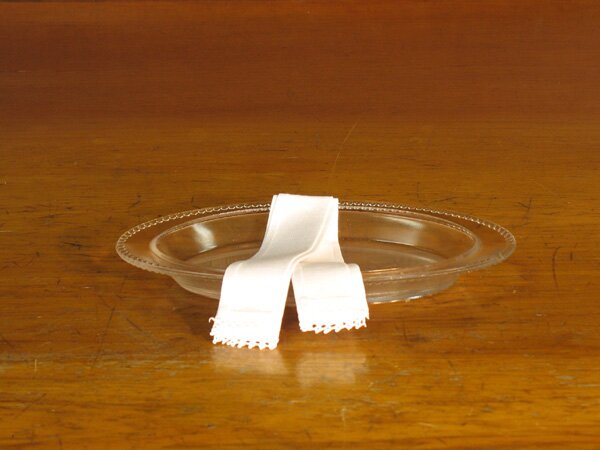
Lavabo Finger Towel on another Lavabo Basin
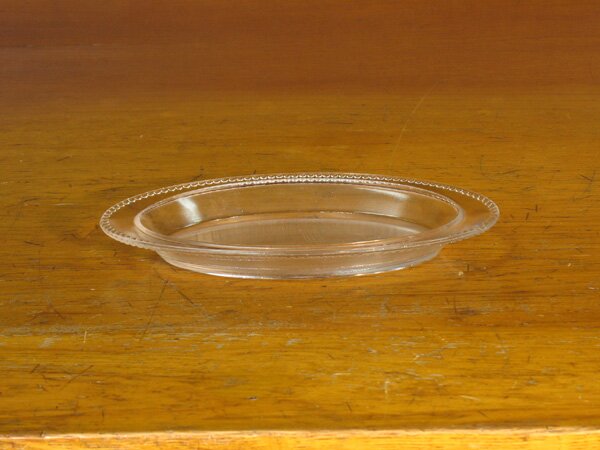
Lavabo Basin
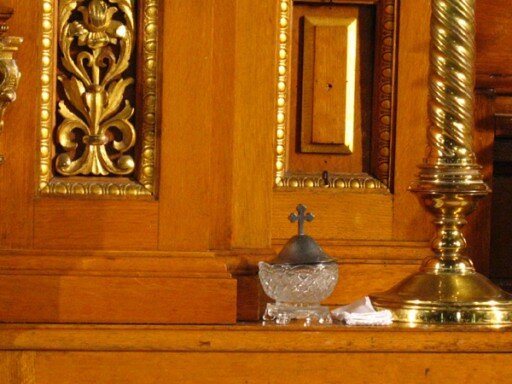
Ablution Cup with White Finger Towel
It sit next to, or very close to, the Tabernacle on right-hand side. It is used by Mass Celebrant to purify his right hand thumb and forefinger after Holy Communion if he gives Holy Communion outside of Mass, or both of his thumbs and forefingers if he binates and says another Mass immediately following the current Mass.
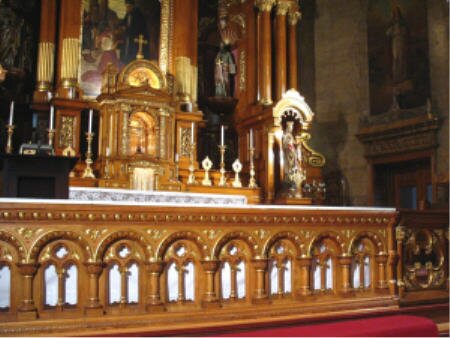
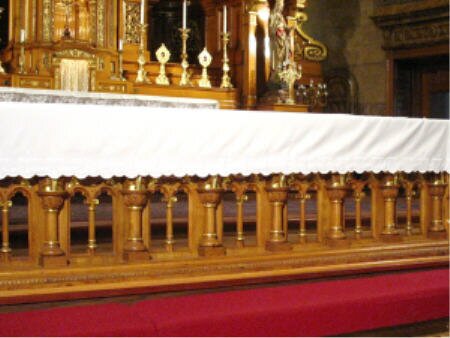
Communion Rail
Note the long red cushion on which the Communicants are to kneel to Receive Holy Communion.
Note the long white Communion Cloth which is draped over the top and then down the opposite side on the front of the Communion Rail. This is done by two Altar Boys before Holy Communion. Communicants are to kneel and place both of their folded hands under the Communion Cloth. This way, if a Consecrated Host accidently falls and somehow misses falling onto the Communion Paten, which the Altar Boy holds under the chin of each Communicant, the Sacred Host will then fall onto the Communion Cloth, but will never touch the fingers, thumbs, or hands of the Communicant because only a Priest and a Prelate have their thumbs and forefingers Anointed and Consecrated in order to be able to touch the Sacred Host.

Holy Communion is given on the tongue to those kneeling.
Holy Communion is Administered only by a Priest or a Prelate because only they have thumbs and fingers which have been Consecrated to touch the Sacred Host when they were Ordained to the Holy Priesthood.
The Laity, by definition, have not received the Sacrament of Holy Orders and therefore their thumbs and fingers are forbidden to touch even the Sacred Vessels and never, under any circumstances, are the Laity permitted to touch a Consecrated Host or a Chalice containing the Precious Blood. Communicants do not say anything, not even Amen. Photo taken in Catacombs III.
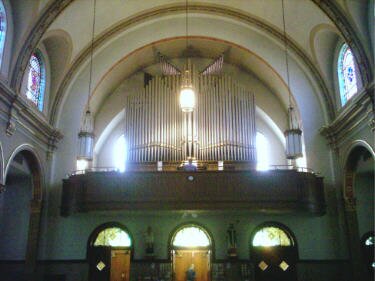
The members of the Choir are not permitted to be in the Sanctuary, but to sing in the Choir Loft.
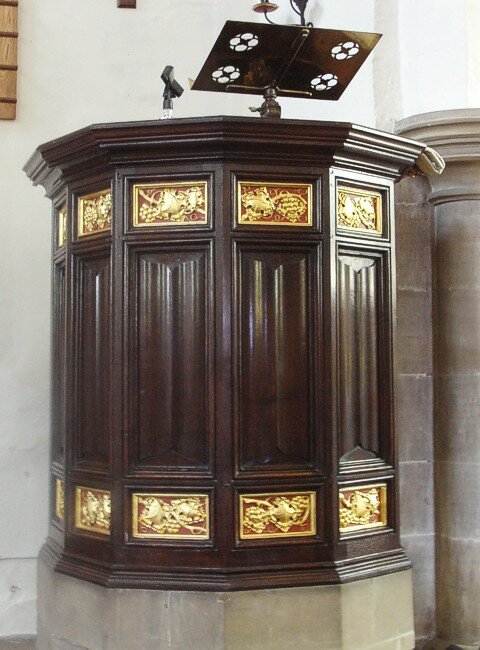
Pulpit for Preaching
Used Only by Priests and Bishops. Total Silence is always Observed in Church except for the Mass Celebrant (a Priest or a Prelate) and the required Responses made by Altar Boys.
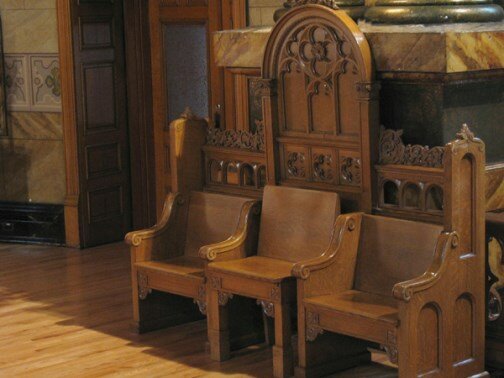
The Mass Celebrant sits in the center flanked on both sides by one Altar Boy. This is used primarily at High Masses when the Mass Celebrant sits after he has finished reading the Gloria and the Creed while he waits for the Choir to finish singing.
During the Creed, the Altar Boys kneel on the bottom Altar step closest to the Sedelia while the Mass Celebrant removes his Biretta and bows his head at the Et incarnatus est.....
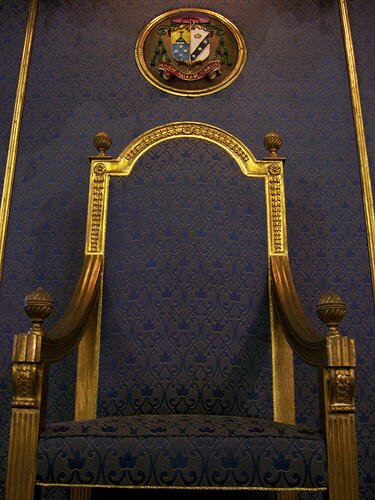
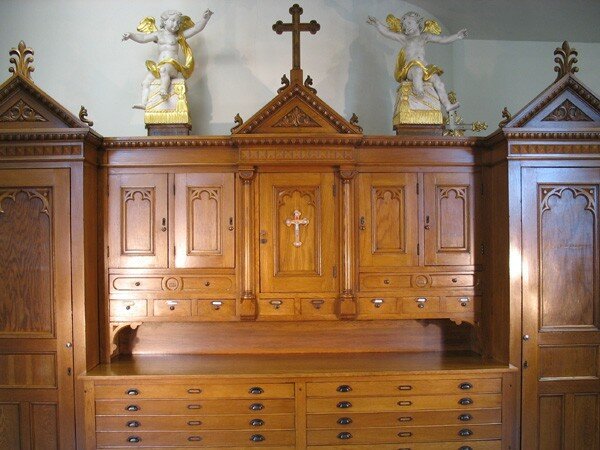
The Sacristy is a room off the Epistle side of the Altar from which the Mass Celebrant goes to and from the Altar. Priestly Vestments for Mass, Benediction, etc. are kept in the draws, etc.
Missals, Rituals, unconsecrated Mass Hosts, Chalices, Ciboria, Monstrances, etc. are kept in the top portion.
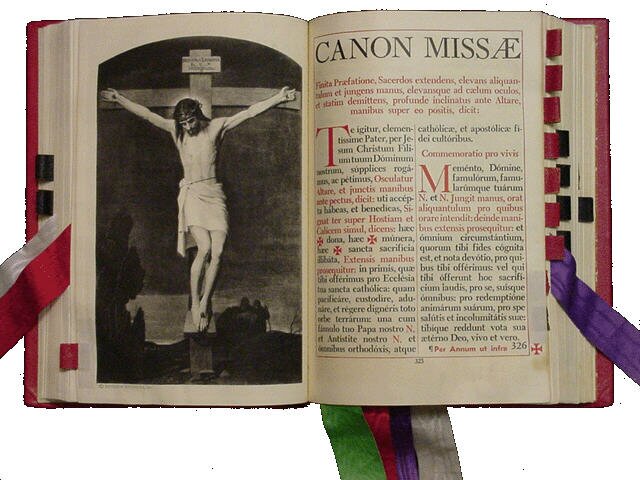
The Mass was always in Latin.

The Mass Celebrant (a Priest or a Prelate - a Bishop)
read the Mass from the Missal which was in Latin.

Pope Saint Leo I
Some Liturgists claim that this Missal for the Mass has been traced back to the Leonine Sacramentary of Pope Saint Leo I [Saturday, September 29, 440 - Thursday, November 10, 461].
Pope Saint Gelasius I
Pope Saint Gelasius I [Saturday, March 1, 492 - Wednesday, November 21, 496] used this same “Missal” called the Leonine Sacramentary of Pope Saint Leo I and had copies made of it probably to replace the older copies which were wearing out.
This re-issued edition is called the Gelasian Sacramentary. According to some Liturgical historians, both Sacramentaries are similar to the 1943 and earlier editions of the Missale Romanum (in Latin, of course) which Mass Rite some pre-Vatican 2 Liturgists call the Ancient Roman Rite.
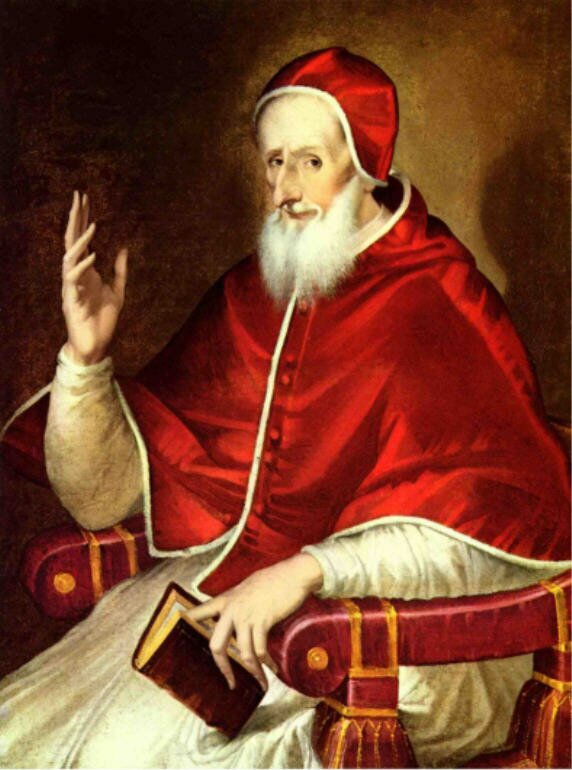
Pope Saint Pius V
Pope Saint Pius V restored the Missale Romanum to the original purity of the Missals (Sacramentaries) used by Pope Saint Leo I and Pope Saint Gelasius I.
Pope Saint Pius V then promulgated the restored Missale Romanum on Tuesday, July 14, 1570, forbidding all changes to it (except for new feast days and rubrical clarifications) under censure of excommunication in his Papal Bulla, Quo Primum Tempore, of Tuesday, July 14, 1570.

The Priest faced the Altar.
This Photo is of the Consecration of the Sacred Host. If you look very closely, you will see that the Mass Celebrant is holding the large host.
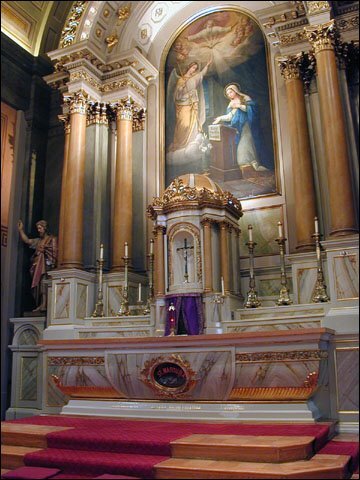
The Altar was fastened securely to the back wall at the center of the Sanctuary.
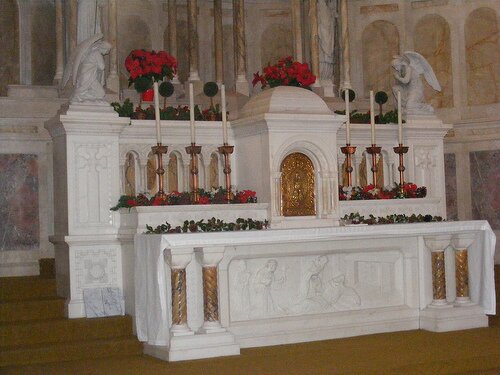
Another Example of a Marble Altar with the Tabernacle in the center.
This one has a gold Tabernacle door.
The Tabernacle was fastened securely to the top of the back of the Altar
and also sometimes to the back wall of the Sanctuary.
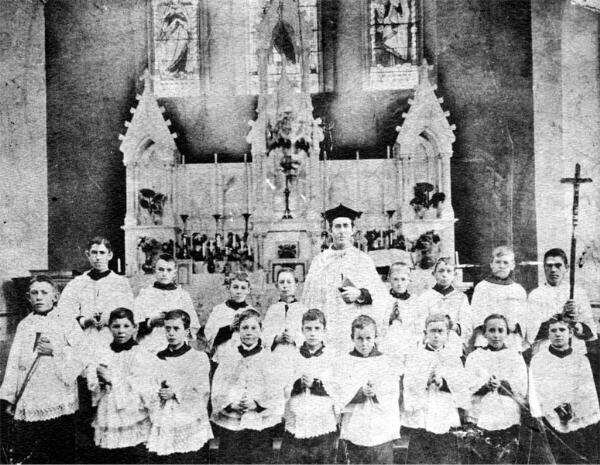
There were only Altar BOYS.
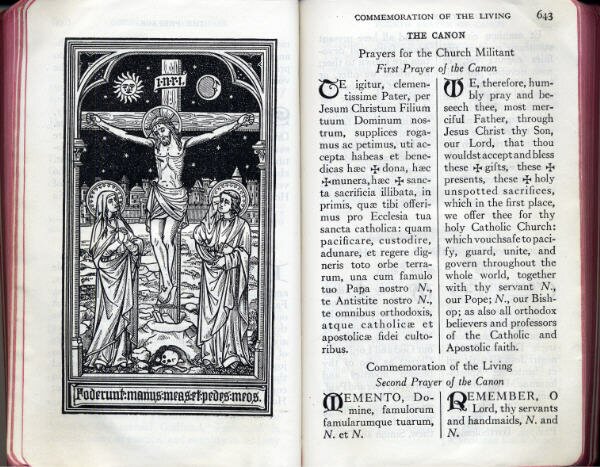
Hand Missal Printed in 1943
The Congregation followed the Mass in their hand-size Missals. These Hand Missals were printed as far back as at least 1900 A.D. - probably much earlier? Latin was always on the left and the English translation was always on the right.

Even 10 Years Later - Hand Missals Were Still Printed in both Latin and English
In the above 1953 hand-size Missal Latin is still on the left and the English translation is still on the right.
So there was no need for an "English Translation" of the Mass for the Laity! The Laity already had an English Translation in their Hand Missals since at least 1900 A.D.! It is Past Time for all of the Lies to Stop!!!
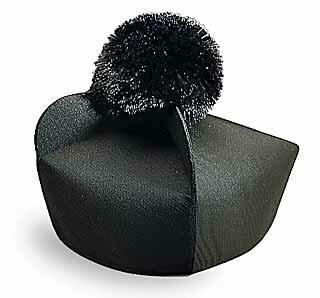
Biretta
The Mass Celebrant, either a Priest - who wore a Black Biretta - or a Prelate - who wore a Roman Purple Biretta, wore a Biretta when processing from the Sacristry to the Altar, when sitting on the Sedelia (Priest) Episcopal Throne (Prelate) during a High Mass, and when processing from the Altar to the Sacristry after reciting the Prayers after Low Mass.
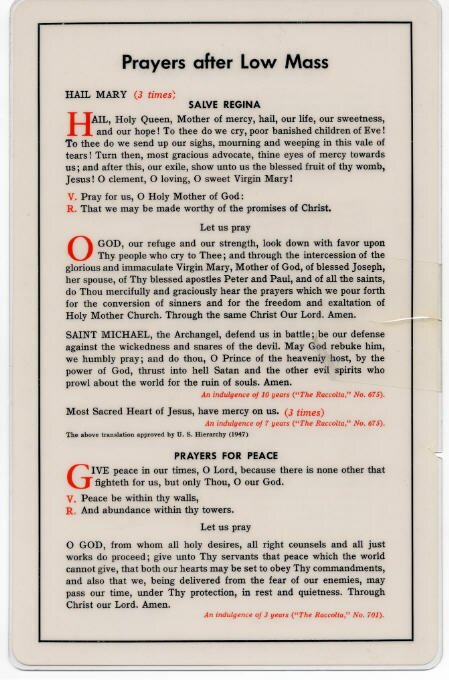
Prayers after Low Mass Card
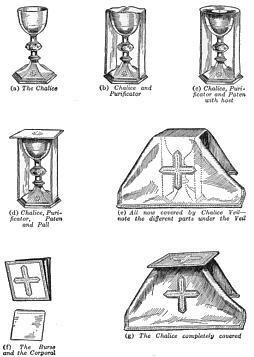
How the Chalice is Prepared for Mass
Catholic Traditional Mass Vestments Worn by Priests
Given in the Order in which they were put on
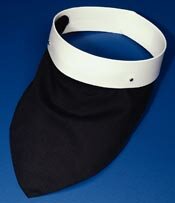
Black Cassock Rabat with White Roman Collar

Black Cassock for Priests
(Photo also shows White Roman Collar - the Black Cassock Rabat is not showing)

Black Cassock Cincture
The Priest is already wearing his Black Cassock, Black Cassock Rabat with White Roman Collar, and Black Cassock Cincture before he begins to vest for Mass
Before putting on any Mass Vestments, the Mass Celebrant always washed his hands first reciting the require prayer.
When vesting with each garment, the Priest would always recite the prayer for that particular Mass Vestment.

Amice

Alb

Cincture

Maniple

Stole

Chasuble and Biretta
Carrying the Chalice to the Altar
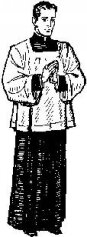
Altar Boys wore a Cassock - Usually Black
Over which they put a White Surplice.
It is similar to a Priest's Black Cassock and White Surplice except the obvious smaller size for both Cassock and Surplice. Also, Altar Boys wore neither a Black Cassock Rabat nor a White Roman Collar, nor a Black Cassock Cincture.
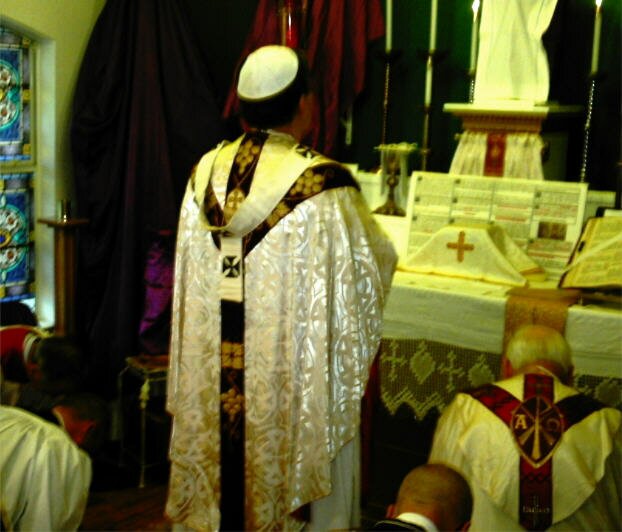
Prayers at the Foot of the Altar
During a Pontifical Low Mass
The Prayers at the Foot of the Altar were recited at the Foot of the Altar, after which the Priest ascended the Altar Steps. During the Prayers at the Foot of the Altar, both the Priest and the Altar Boys, in turn, recited the Confiteor.
Among many other things, e.g. moving the Missal on the Missal Stand from the Epistle Side of the Altar (after the conclusion of the Epistle and the prayers after it) to the Gospel Side of the Altar. After Holy Communion, the Altar Boys would move the Missal on the Missal Stand back to the Epistle Side of the Altar.
During the Mass, the Altar Boys would also bring the wine and the water cruets to the Priest, walking up the steps of the Altar on the Epistle side of the Altar from the Credence Table. After that, they washed the thumbs and forefingers of the Priest.
Before Holy Communion, the Altar Boys would go to the Communion Rail to turn the Communion Cloth onto the top of the Communion Rail and would also let part of it hang down over the side of the Communion rail so the Laity, when kneeling, could put their folded hands under the Communion Cloth so that the Consecrated Host, if it fell, would never touch their fingers or hands in any way.
Only the specially Consecrated hands and fingers of Priests and Bishops could touch a Consecrated Host.
The Altar Boys also recited the Confiteor before the Priest gave them Holy Communion as they knelt on the Predella (top platform on which the Altar sat). The Priest then walked down the Altar Steps to the Communion Rail to give Holy Communion to those kneeling at the Communion Rail.

|
|
|
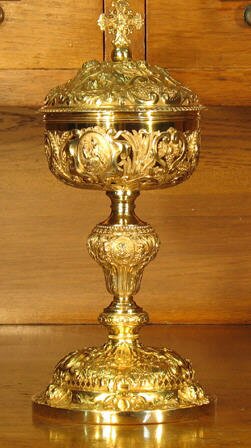
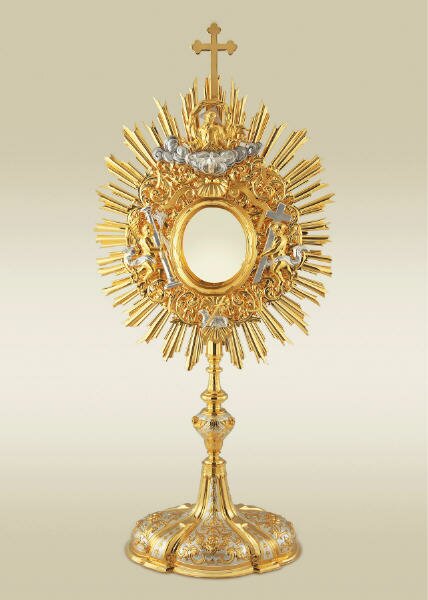
Only Priests, and Bishops could touch any Sacred Vessel, e.g. the Chalice, Chalice Paten, Ciborium, Monstrance, etc.
Deacons could only touch the empty Sacred Vessels, i.e. the Chalice, Ciborium, and Monstrance and the other Sacred Vessels, e.g. Chalice Paten.

Only Priests and Prelates (Bishops, Archbishops, etc.)
could give Holy Communion.

Holy Communion was only given in the form of a small
( 1 1/8" diameter), very, very thin, white host.
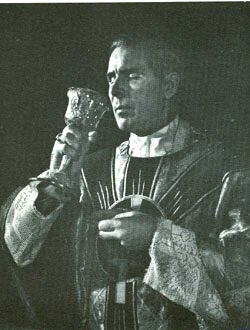
The Precious Blood was consumed only
by the Mass Celebrant - a Priest or Prelate.
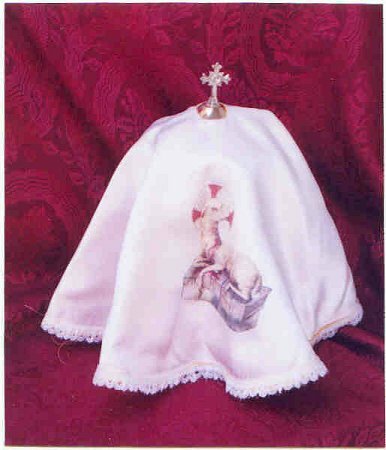
Ciborium with top in place
Covered with a White Cover
The White Cover indicated Consecrated Hosts were in the Ciborium. The Consecrated small, thin, white hosts were kept in a Ciborium which was kept in the Tabernacle except for administering Holy Communion.
Holy Communion was received kneeling on the tongue at the Communion Rail
The Communicant remained totally silent before, during, and after receiving the Sacred Host.
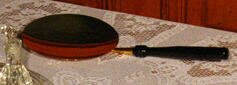
An Altar Boy would place a Paten, which had a handle on it about 12" long, under the chin of each Communicant to whom the Priest was about to give Holy Communion so that if a Consecrated Host fell, it would not fall on the floor, but onto the Paten instead.

Except on All Souls Day, each Mass could be offered for only one intention. More than one intention was prohibited.

During the Holy Sacrifice of the Catholic Ancient Mass, the Chalice and Host were always set on top of the third Altar Cloth directly over the marble Altar Stone which contained the relic of at least one Saint, usually the Patron Saint of the Church, which relic was cemented into a small cavity which had been made in the marble Altar Stone.
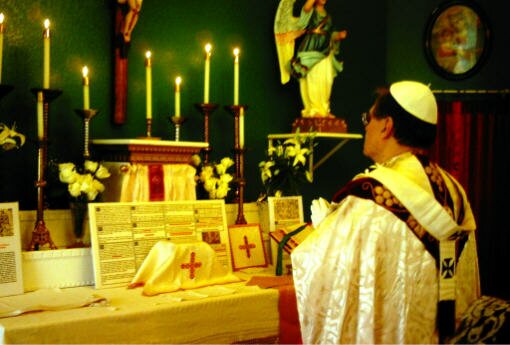
Mass Vestments were made of silk or other expensive material. All Liturgical Vestments, especially Mass Vestments, were a beautiful work of art.
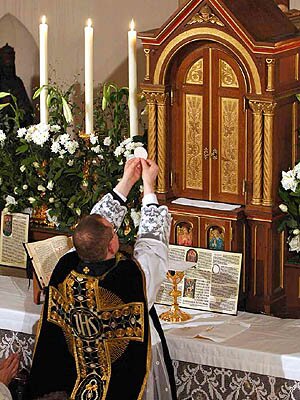 Black Requiem Mass Vestments |
 Missae Defunctorum |
Black Vestments were always used for funeral Masses, Masses for the Dead, Good Friday, and the three Masses on All Souls' Day. Except for Good Friday a Special Requiem Missal called the Missae Defunctorum is used.

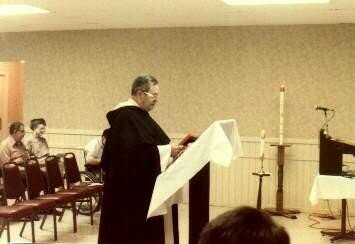
Only the Priest gave a Sermon.
Only the Priest spoke to the Congregation.
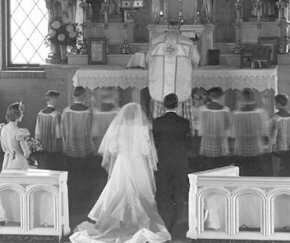
The Laity, except for Altar Boys, always remained on their side of the Communion Rail, the gates of which were always closed usually with only a few exceptions - Weddings, Funerals, and the three Processions.
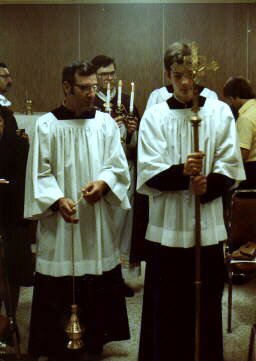
Holy Saturday Procession
The three Processions were usually held, one on Holy Thursday, Holy Saturday, and the other on Corpus Christi.
Prelates (i.e. Bishops of whatever rank of ecclesiastical jurisdiction - Bishops, Archbishops, Metropolitan Archbishops, Primates, Cardinals, and Patriarchs) would sometimes enter the Church in a Solemn Procession in which case the gates of the Communion Rail would be opened before the Mass, but closed after everyone in the Procession had entered the Sanctuary. The gates would be re-opened after the Pontifical Low Mass, or Pontifical High Mass, or Pontifical Solemn High Mass was over so the Procession could exit the same way it entered the Church with the Prelate.
Silence was a hard and fast rule which was required of everyone in the Church except for the Priest and the responses made by the Altar Boys.
There was no shaking hands with anyone before, during, or after the Mass inside the Church. The focus was always on God not on people.
Most Churches had at least Two Side Altars
On on Each Side of the Main or High Altar
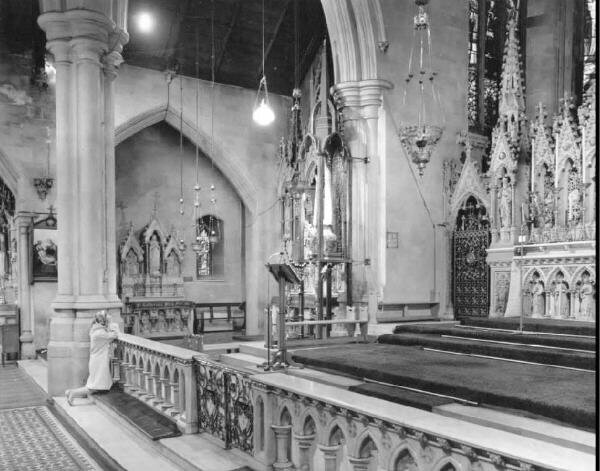
This Photo Shows the Left [Gospel] Side of the High or Main Altar
And One Large Side Altar with a Small Side Altar to the left of it
Notice the Marble Altar Railing with the Gates in the Center.
Beautiful statues of Our Lord, Our Blessed Mother, and the Saints filled the Sanctuary and each Side Altar had one such statue set on top of its Tabernacle, which was also attached to its respective Altar, which Altar was also fastened to the back of the wall in the Sanctuary.
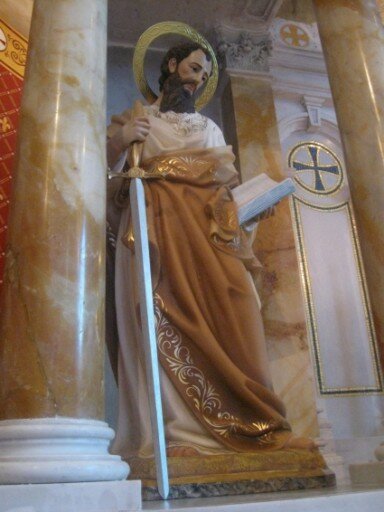 Statue of Saint Paul |
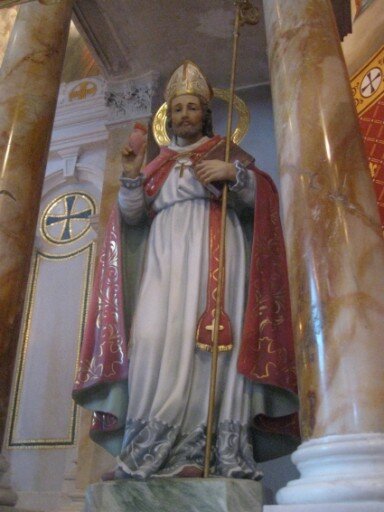 Statue of Saint Augustine |
Various Churches also had beautiful statues in other places in their Churches. The above are a but examples of the fine artistry that made each statue "Heavenly". Notice the attention to detail and the life-like features of the faces, the great attention to every detail, and the beautiful trims.
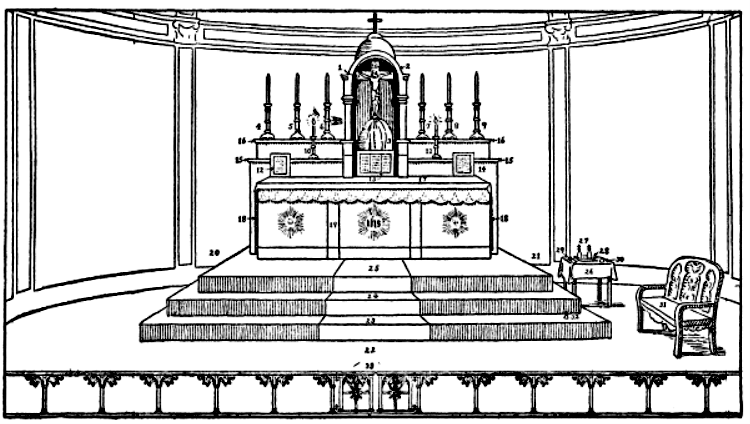
Depending on the Church, the High Altar had from three to fifteen steps.
The Choir Loft was only for the members of the Choir.
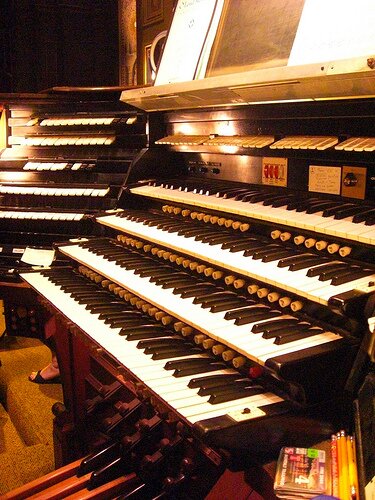
Only one musical instrument was permitted - the organ.
After the Gloria on Holy Thursday until the Gloria on Easter Saturday, no music was permitted and the bells were not rung - instead a special wooden clapper was used in place of the bells.
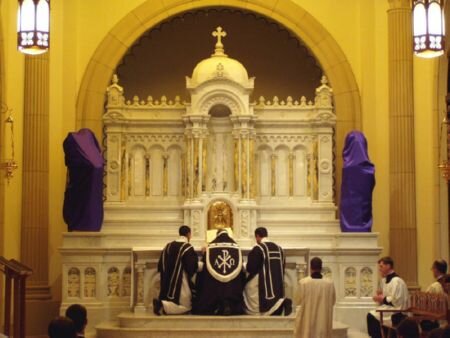
Good Friday was only the Mass of the Pre-Sanctified.
Holy Saturday had the reading or chanting of the twelve prophecies.
Holy Saturday's new fire lit one of the three candles of the triple candlestick which was carried in procession to the High Altar where the Pascal Candle had been set in its special candlestick.
The Pascal Candle was lit from one of the three candles of the triple candlestick.
No nails were put into the Pascal Candle in the form of the Jewish Star of David, but instead five grains of incense were applied in the form of a Greek Cross + to the Pascal Candle.
Votive candles were made of wax - they were not electric lights.
Religious items for the home could be purchased in the vestibule of the Church after Mass in some Churches, and especially before Christmas.
There were Low Masses, High Masses, Solemn High Masses, and Pontifical Masses.

Benediction of the Blessed Sacrament was always done after the High Mass was over.
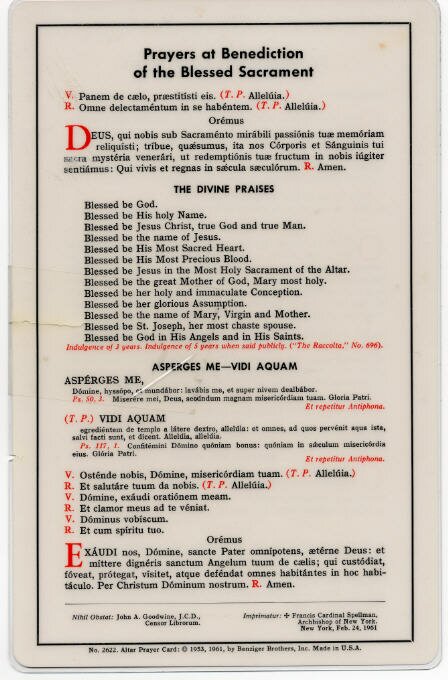
Card used by the Priest for the Prayers at the Benediction of the Blessed Sacrament
This card was also used before the Sunday High Mass for the Asperges
(Vidi Aquam in Paschal Season) when the Priest Blessed the Congregation.
The Tabernacle was set into the center of the High Altar.
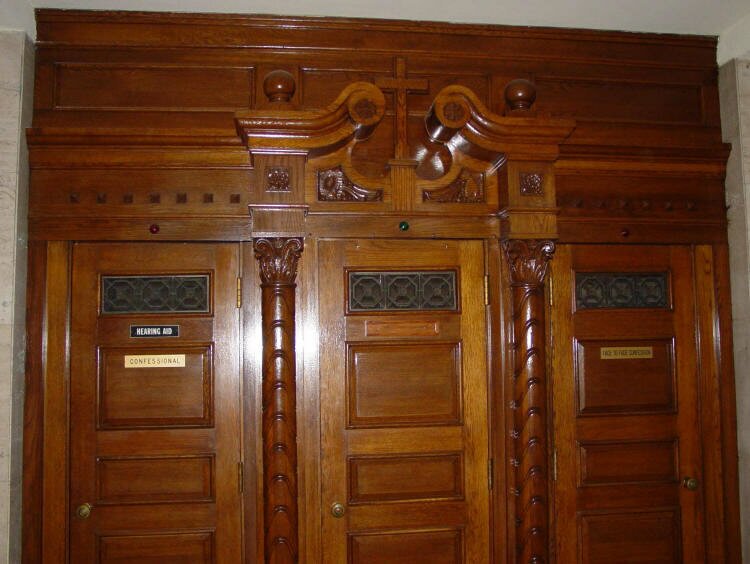
Traditional Confessional
Confessions were heard in sound-proof (to keep the Seal of Confession intact) "Confessionals" which were either built into the walls in the back of the Church or on the sides of the Church. In the above photo, the door on the left indicates there is a hearing aid inside it. Even though Confessionals were supposed to be sound-proof, both the Confessor and Penitent usually spoke either in a whisper or in a very low tone of voice in order to protect the Seal of Confession.

Going to Confession
This cut-away view shows the interior of the Confessional. The Confessional "screen" was usually much smaller than the one depicted in the graphic.
The Priest hearing Confessions sat in the center cubicle while penitents would enter the outer cubicles, close the door, and kneel down to wait for the Priest to open the small, sliding door to hear your Confession.

In this photo, He is obviously Confirming Grade-School Children. It was Traditional for those to be Confirmed to wear a "Confirmation Gown" which was somewhat similar to a Graduation Gown, except the color was always the same for everyone. Notice the Boys have a Male Sponsor and the Girls a Female Sponsor. Each Sponsor (God Parent) physically touched the right shoulder of the one to be Confirmed with his/her right hand.
 |
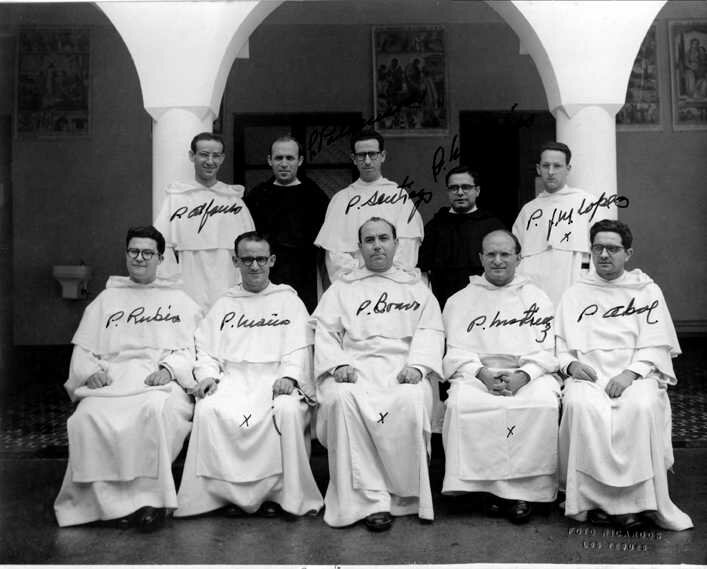 |
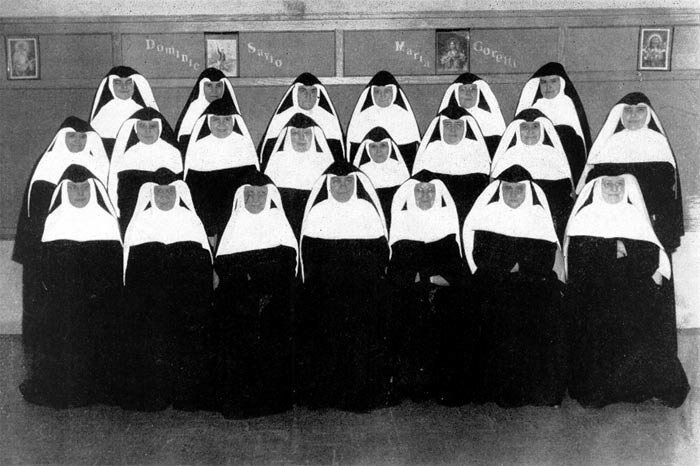
Male and Female Members of Religious Orders wore the Traditional Habit of their Respective Order and Obeyed the Holy Constitutions for which their Saintly Founder(s) received approval from the Pope, in some cases many, many Centuries before the 20th Century.
 Please Click Here for the Holy Rosary Web Page |
Our Blessed Mother asks that all Catholics Pray her Traditional Rosary daily.
The Rosary will really make a Powerful difference in Your Life! |
“Now the God of Hope fill you with all joy and peace in believing; that you may abound in Hope, and in the power of the Holy Ghost” (Romans 15:13).
“Charity is patient, is kind: Charity...beareth all things, Believeth all things, Hopeth all things, endureth all things” (1 Corinthians 13:4, 7).
“Now Faith is the substance of things to be Hoped for, the evidence of things that appear not” (Hebrews 11:1).


Thank you for stopping by to visit the Shrine of Saint Jude web site. You are welcome to visit us again, as often as you like.
If you like our newly redesigned and improved web site, please share this information with others and help them to know more about how powerful Saint Jude really is and that God still works "miracles" today!
Have a Wonderful Day!
God Bless You!
mmm
Father Michael